
 +65 6253 7296

Sleep apnoea can go unrecognised for years because its symptoms are not always easy to distinguish from the effects of a busy schedule, a young family or long working hours. As a result, the breathing problem occurring during sleep may remain unnoticed.
If you wake feeling unrefreshed most mornings, or a partner has mentioned loud snoring or pauses in your breathing, you are not alone. Many people live with these signs for some time before seeking further assessment. Recognising a recurring pattern can be a useful first step towards understanding what may be affecting your sleep.
Dr Gan Eng Cern, an ENT Specialist at Mount Elizabeth Novena Hospital, notes that obstructive sleep apnoea is both common and treatable, and that the signs are frequently noticed by a bed partner before the person who is affected.
This guide sets out the eight signs of sleep apnoea worth watching for, how to tell ordinary snoring apart from a breathing problem and two short self-checks you can do. It then explains how assessment usually works in Singapore, the main treatment options and the simple steps you can take while you arrange a review.
Tiredness alone is easy to explain away. When several signs occur together and a partner notices changes in your breathing, that pattern is the signal to seek assessment.
How Common Is Sleep Apnoea in Singapore?
Sleep apnoea, also written sleep apnea, is relatively common in Singapore. The Singapore Health Study 2012, reported by Tan and colleagues in Respirology in 2016 and cited in the 2025 Singapore consensus statements on the management of obstructive sleep apnoea, estimated that 30.5% of adults aged 21–79 had moderate-to-severe OSA.
moderate-to-severe OSA (Singapore Health Study)
worth watching for
self-screening tools
Obstructive sleep apnoea occurs when the upper airway repeatedly narrows or closes during sleep. This can reduce or temporarily stop airflow, leading to brief arousals that fragment sleep, often without the person being aware of them. Recognising possible signs can help you understand when further assessment may be appropriate.
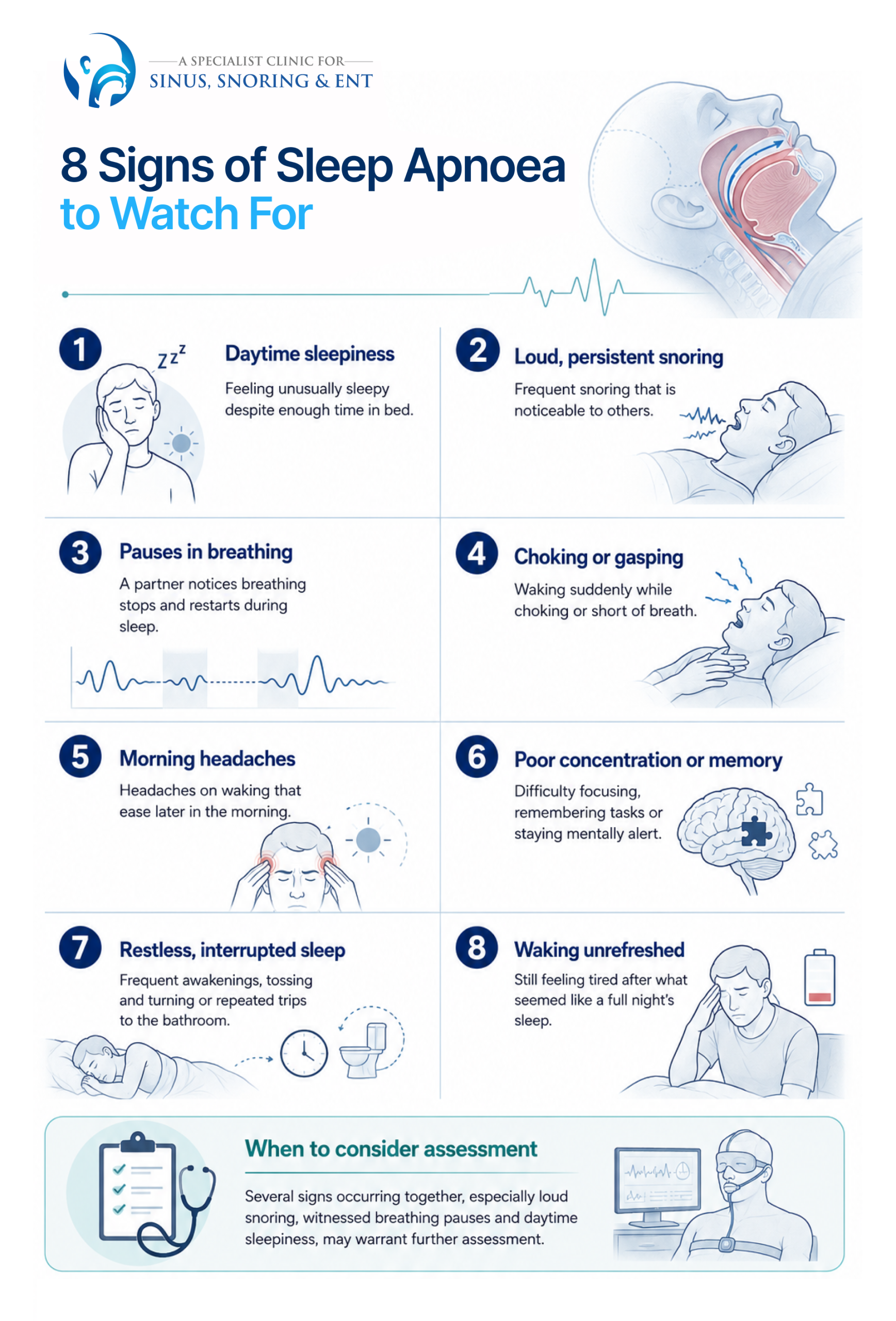
The 8 Signs of Sleep Apnoea to Watch For
Tiredness alone can be easy to attribute to a demanding schedule. When several of the signs below occur together, especially when a partner notices changes in your breathing during sleep, further assessment may be appropriate.
| # | Sign | What It May Suggest |
|---|---|---|
| 1 | Daytime sleepiness that rest does not resolve | Sleep fragmented by repeated arousals overnight |
| 2 | Loud, persistent snoring | Often the first sign a partner notices |
| 3 | Witnessed pauses in breathing | A recognised sign of OSA when observed by a partner |
| 4 | Choking or gasping during sleep | A narrowed or blocked airway triggering brief arousal |
| 5 | Morning headaches | May relate to disrupted sleep and overnight oxygen changes |
| 6 | Difficulty concentrating or memory lapses | May be associated with poor-quality sleep |
| 7 | Restless, fragmented sleep | Repeated awakenings or more frequent night-time waking |
| 8 | Waking unrefreshed | Sleep may be fragmented or non-restorative |
1. Daytime Sleepiness That Rest Does Not Resolve
Getting enough time in bed but still struggling to stay alert during the day can be a sign of obstructive sleep apnoea. You may find yourself dozing off during meetings, while reading or watching television. Feeling sleepy while driving is a safety concern and should not be ignored. In OSA, repeated reductions or pauses in breathing can trigger brief arousals that fragment sleep, often without you being aware of them.
2. Loud, Persistent Snoring
Snoring associated with OSA is often loud and habitual rather than occasional, and it may be the first sign noticed by a partner. Snoring alone does not confirm OSA, but when it occurs alongside other signs listed here, it may increase suspicion of the condition.
3. Witnessed Pauses in Breathing
A partner who notices you appear to stop breathing and then restart with a snort or gasp may be observing a recognised sign of OSA. In adults, an apnoea is formally scored during a sleep study when airflow falls by at least 90% for 10 seconds or longer. A partner's observations cannot confirm an apnoea, but noting the pattern or recording a short video may provide useful information to share with a doctor.
4. Choking or Gasping During Sleep
Waking suddenly with a choking sensation or gasping for air may occur when a narrowed or blocked airway triggers a brief arousal from sleep. These episodes can be short and may not be clearly remembered the next morning.
5. Morning Headaches
A dull headache on waking that improves within the first few hours may occur in people with OSA. It may be related to disrupted sleep and changes in oxygen or carbon dioxide levels overnight, although morning headaches can have many other causes. If they occur together with loud snoring, witnessed breathing pauses or daytime sleepiness, mention the pattern to your doctor.
6. Difficulty Concentrating or Memory Lapses
Trouble maintaining attention, re-reading the same email or forgetting routine tasks may be associated with poor-quality sleep, although these difficulties can also have other causes, including stress, insufficient sleep and certain health conditions. Treating OSA may improve some aspects of attention and thinking, but the degree of improvement varies between individuals.
7. Restless, Fragmented Sleep
Frequent tossing and turning, repeated awakenings or waking to use the bathroom more often than usual may occur when sleep is repeatedly disrupted. These symptoms are not specific to OSA, but noting how often they happen can help provide a clearer picture of your sleep pattern.
8. Waking Unrefreshed
Consistently waking feeling tired despite allowing enough time for sleep may suggest that your sleep is fragmented or non-restorative. This can occur with OSA, but it may also have other causes.
Some people with OSA also experience night sweats, changes in mood or blood pressure that is difficult to control. A prospective study published in the New England Journal of Medicine in 2000 found an association between sleep-disordered breathing and the development of hypertension. If several of these signs occur together, especially alongside loud snoring or witnessed breathing pauses, further assessment may be appropriate.
Snoring Versus Sleep Apnoea: Why the Difference Matters
Snoring and sleep apnoea are not the same condition, and understanding the distinction can help determine whether further assessment may be appropriate.
Simple Snoring
Caused by tissues in the upper airway vibrating as air passes through during sleep. It can disturb a partner's sleep, but it does not necessarily involve repeated reductions or pauses in breathing.
Obstructive Sleep Apnoea
The airway repeatedly narrows or closes enough to reduce or stop airflow, leading to brief arousals and fragmented sleep. Loud snoring interrupted by silences, gasping or choking may raise suspicion of OSA.
A partner's observations can provide useful clues. Loud snoring interrupted by silences, gasping or choking may raise suspicion of OSA. However, steady snoring without obvious pauses does not rule it out, as breathing changes may not always be noticed.
For a fuller comparison, our guide to snoring versus sleep apnoea explains the differences in more detail. Untreated OSA is associated with health conditions including high blood pressure and cardiovascular disease. This does not mean that everyone who snores has OSA, but persistent snoring accompanied by daytime sleepiness, witnessed breathing pauses or unrefreshing sleep may warrant further assessment.
A Quick Way to Screen Your Risk
Two short, widely used questionnaires can provide an initial indication of possible OSA risk. They do not diagnose or rule out sleep apnoea, but the results may provide useful information to discuss with a doctor.
The STOP-Bang Questionnaire
Answer yes or no to each question. Each "yes" scores one point.
| Letter | Question |
|---|---|
| S — Snoring | Do you snore loudly — louder than talking or loud enough to be heard through a closed door? |
| T — Tiredness | Do you often feel tired, fatigued or sleepy during the daytime? |
| O — Observed | Has anyone seen you stop breathing during sleep? |
| P — Pressure | Do you have high blood pressure, or are you receiving treatment for it? |
| B — BMI | Is your body mass index greater than 35 kg/m²? |
| A — Age | Are you older than 50? |
| N — Neck | Is your neck circumference greater than 40 cm? |
| G — Gender | Are you male? |
Under the standard STOP-Bang scoring system, the total score indicates a risk band. Some people with an intermediate score may be reclassified as high risk when additional factors are present.
A higher score does not confirm OSA, and a low score does not completely rule it out. If the result occurs alongside loud snoring, witnessed breathing pauses, gasping or significant daytime sleepiness, discussing the pattern with a doctor may be appropriate.
The Epworth Sleepiness Scale
This scale asks how likely you are to doze off in eight everyday situations, with each item scored from 0 to 3. A total score above 10 generally suggests excessive daytime sleepiness. Developed by Johns in 1991, the scale provides a structured way to describe sleepiness and share the result with a clinician. It does not diagnose OSA or identify the cause of your tiredness.
Record Your Sleep
A phone recording may capture loud snoring, gasping or pauses in breathing that you are unaware of during sleep. A partner may also record a short episode if one is observed. These recordings cannot diagnose or rule out OSA, but they may provide useful context to share with a doctor alongside your symptoms and screening results.
Build a Short Symptom Record Before Your Appointment
A brief log may help you describe your symptoms and sleep pattern more clearly, particularly when tiredness makes details difficult to recall during an appointment.
| Column | What to Note |
|---|---|
| Date | The day each observation was made |
| Symptom | What you noticed — snoring, gasping, headache, sleepiness |
| Perceived severity (1–10) | A personal tracking score only — it does not indicate how mild or severe OSA may be |
| Daytime impact | Sleepiness, low energy or difficulty concentrating during the day |
| Witnessed? | Whether a partner observed snoring, gasping, choking or apparent pauses |
Over several days, add a short note each morning about how refreshed you feel, whether you have a headache and how often you remember waking. During the day, note periods of sleepiness, low energy or difficulty concentrating. Before your appointment, highlight recurring symptoms and any witnessed changes in breathing.
Getting Assessed in Singapore
Where you begin may depend on your symptoms, medical history and whether you prefer to enter the public or private healthcare system.
Many people start with a GP or polyclinic doctor, who can review their symptoms, examine relevant risk factors and refer them for a sleep assessment or specialist review where appropriate. A polyclinic referral is generally required for subsidised care at a public specialist outpatient clinic.
An ENT specialist may be involved when nasal obstruction, enlarged tonsils or another structural narrowing of the upper airway is suspected, or when assessment of possible surgical options is relevant. Depending on the individual, evaluation may also involve a respiratory physician, sleep specialist or multidisciplinary sleep service.
Direct private specialist appointments are also available. This may be considered when there are witnessed breathing pauses, persistent daytime sleepiness, suspected upper-airway obstruction or continuing symptoms despite previous management. A sleep study may then be recommended to confirm whether OSA is present and assess its severity. Our consultation cost guide provides general information on the possible steps and charges involved.
Sleep Studies: Home Test or In-Laboratory
Home Sleep Apnoea Test (HSAT)
A portable device worn overnight at home. It may be suitable for uncomplicated adults whose symptoms and risk factors suggest moderate-to-severe OSA. It may report a respiratory event index because it does not always measure actual sleep time.
In-Laboratory Polysomnography (PSG)
The more comprehensive test and the reference standard. It may be recommended for more complex cases, when central sleep apnoea or another sleep disorder is suspected, or when a home test is negative, inconclusive or technically inadequate.
Both tests are non-invasive, and the appropriate option depends on the individual clinical assessment. A sleep study records breathing events during the night. In PSG, these are commonly expressed as the apnoea–hypopnoea index (AHI), which is the average number of apnoeas and hypopnoeas per hour of sleep.
The result is considered together with symptoms, oxygen levels, medical history and other findings when management options are discussed.
| Severity (Adults) | Apnoea–Hypopnoea Index (AHI) |
|---|---|
| Mild | AHI 5 – 14.9 |
| Moderate | AHI 15 – 29.9 |
| Severe | AHI 30 or above |
Concerned About Signs of Sleep Apnoea?
Treatment Options
There is no single treatment that is appropriate for everyone. The choice depends on the severity of OSA, symptoms, airway anatomy, other health conditions, personal preferences and how well each option can be used consistently. Follow-up may include reviewing symptoms and treatment data to assess whether the chosen approach is suitable.
CPAP
Pressurised air through a mask to help keep the upper airway open during sleep. Commonly recommended for moderate-to-severe OSA.
Oral Appliances
A custom mandibular advancement device holds the lower jaw slightly forward to open the airway. May suit some mild-to-moderate OSA.
Weight & Lifestyle
Where excess weight contributes, weight reduction may lower breathing events. Limiting alcohol near bedtime and managing nasal congestion may also help.
Surgery
Where airway anatomy contributes, procedures may address the nose, tonsils, palate, tongue base or jaws, sometimes at more than one level.
CPAP
Continuous positive airway pressure (CPAP) delivers pressurised air through a mask to help keep the upper airway open during sleep. It is commonly recommended for moderate-to-severe OSA, although the most appropriate treatment depends on the individual assessment. Mask fit, pressure settings and comfort can affect how easily CPAP is used. Education, early follow-up and troubleshooting may help address problems such as air leaks, dryness or discomfort. Heated humidification may also reduce nasal or throat dryness for some users, depending on their symptoms and preferences.
Oral Appliances
A mandibular advancement device is a custom-made dental appliance that holds the lower jaw slightly forward during sleep. This can increase the space in the upper airway and reduce its tendency to narrow or collapse. It may be considered for some people with mild-to-moderate OSA, or when CPAP is not tolerated or preferred. Suitability depends on factors such as dental and gum health, jaw-joint function, airway anatomy and the findings of the sleep assessment. The device is portable and may be convenient for travel, although follow-up is needed to adjust the fit and confirm that it is adequately controlling the OSA.
Weight Management and Lifestyle
Where excess weight contributes to OSA, weight reduction may lower the number of breathing events during sleep. A longitudinal study published in JAMA in 2000 found that changes in body weight were associated with corresponding changes in sleep-disordered breathing severity. A secondary analysis of the MIMOSA randomised clinical trial, published in the Journal of Clinical Sleep Medicine in 2022, also reported a dose-response relationship, with greater weight loss generally associated with larger improvements in the apnoea–hypopnoea index. Weight reduction does not necessarily resolve OSA, and follow-up testing or other treatment may still be needed. Limiting alcohol near bedtime, avoiding non-prescribed sedating substances and discussing prescribed sedatives with a doctor may also be relevant. Managing nasal congestion can improve nasal breathing and may make treatments such as CPAP easier to use, although it does not usually address all causes of OSA.
Surgery
When upper-airway anatomy contributes to OSA, surgery may be considered as part of the treatment discussion. This may be relevant when there is an identifiable structural narrowing, when other treatments are unsuitable or not well tolerated, or when surgery could support the use of another treatment. Depending on the site or sites of obstruction, procedures may address the nose, tonsils, palate, tongue base or jaws. More than one procedure may sometimes be considered when narrowing occurs at multiple levels. An ENT assessment can help identify possible anatomical contributors and determine whether a surgical consultation is appropriate. The likely benefits, limitations and risks depend on the individual's sleep-study findings, airway anatomy, medical history and treatment goals. Our sleep apnoea treatment page explains the available options in more detail.
Steps You Can Take While Arranging an Assessment
A few simple measures may reduce snoring or sleep-related symptoms for some people. They do not diagnose or treat the underlying cause of OSA and should not replace medical assessment.
- Try sleeping on your side rather than your back, particularly if your snoring or breathing pauses appear worse when you lie face-up. A body pillow may help you maintain this position.
- Slightly elevating the head of the bed may be comfortable for some people, although the effect varies.
- Avoid alcohol close to bedtime. Do not stop or change prescribed sedatives without first discussing this with your doctor.
- Saline nasal spray may help relieve nasal dryness or congestion. A clean humidifier may also reduce dryness in air-conditioned rooms, but neither measure treats OSA itself.
- Keep reasonably consistent sleep and wake times and allow enough time for sleep.
- Note any changes you observe and share them during your medical assessment.
Need Medical Advice from an ENT Specialist?
No referral is required. Whether you are seeking a diagnosis, treatment advice or a second opinion, Dr Gan provides specialist assessment and personalised treatment planning.
Contact UsPreparing for Your ENT or Sleep Consultation
A little preparation may help you describe your symptoms and concerns more clearly during the appointment. Consider bringing a single-page summary of your three main symptoms, anything you have already tried, your main questions and your main concern.
Questions Worth Asking
| Question | Why It Matters |
|---|---|
| "Which sleep test may be appropriate?" | Based on your symptoms and risk factors, the right test can be matched to your situation. |
| "What information will the test provide?" | Understanding what is measured helps you interpret the result. |
| "What if the first treatment is not tolerated?" | Knowing the alternatives in advance helps you plan next steps. |
| "How will we assess whether treatment is working?" | Follow-up helps confirm the OSA is being adequately controlled. |
If someone has observed your sleep, you may wish to bring them along or ask them to describe any loud snoring, gasping, choking or apparent pauses in breathing. Their observations can provide useful context, although they cannot determine the severity of OSA. Also bring any symptom records, relevant sleep recordings, previous sleep-study reports, a current medication list and any referral letter. Insurance documents may be useful if you plan to check your coverage or administrative requirements.
Why Timely Assessment Is Worthwhile
Obstructive sleep apnoea often persists unless the underlying breathing problem is addressed. Symptoms such as daytime sleepiness, unrefreshing sleep and difficulty concentrating may continue, and untreated OSA is associated with certain longer-term health risks.
OSA can be managed in several ways, depending on its severity, the person's airway anatomy, other health conditions and individual preferences. Appropriate treatment may improve alertness, mood and sleep quality for some people, although the degree and timing of improvement vary.
You do not need to work through every step at once. Recording your symptoms, completing a screening questionnaire such as STOP-Bang or noting observations from a sleep partner can help you prepare for a medical assessment. These steps do not diagnose OSA, but they can provide useful information to discuss with a doctor.
Frequently Asked Questions
- Loud snoring accompanied by witnessed breathing pauses, gasping or choking, together with daytime sleepiness or unrefreshing sleep, are recognised signs of OSA.
- The STOP-Bang questionnaire can indicate possible OSA risk, while the Epworth Sleepiness Scale measures daytime sleepiness. Neither tool provides a diagnosis.
- A short symptom record and relevant sleep recordings may provide useful context during a medical consultation.
- In Singapore, assessment may begin with a GP or polyclinic doctor, or directly with an ENT, respiratory physician or sleep specialist in private care.
- A home sleep apnoea test may be suitable for selected uncomplicated adults, while in-laboratory polysomnography remains the reference standard and provides more comprehensive monitoring.
- Management may include CPAP, an oral appliance, weight management, positional measures and, in selected cases, surgery.
- Recording recurring symptoms and discussing them with a doctor can be a practical first step towards understanding whether further assessment is appropriate.
Screen
Complete the STOP-Bang questionnaire. Note any partner observations of loud snoring, gasping or pauses, or save a short recording.
Summarise
Prepare a one-page summary of your main symptoms, how often they occur and how they affect you during the day.
Assess
Consider a medical assessment if screening indicates increased risk, or with witnessed pauses, gasping or significant daytime sleepiness — via a GP or directly with a private ENT, respiratory or sleep specialist.
Medical Reviewer: Dr Gan Eng Cern
This article is medically reviewed by Dr Gan Eng Cern, a Consultant Ear, Nose and Throat (ENT) Surgeon practising at Mount Elizabeth Novena Hospital, Singapore.
Dr Gan completed a fellowship in rhinology and endoscopic skull base surgery at the St Paul's Sinus Centre, University of British Columbia, Vancouver, and previously served as Deputy Director of the Rhinology Service at Changi General Hospital (2013–2017). His subspecialty interests include rhinology, sinus surgery and skull base surgery. He was a recipient of the Health Manpower Development Programme (HMDP) Award from the Ministry of Health, Singapore.
| Detail | Information |
|---|---|
| Reviewer | Dr Gan Eng Cern |
| Role | Consultant Ear, Nose and Throat (ENT) Surgeon |
| Subspecialty interest | Rhinology, sinus surgery and skull base surgery |
| Fellowship | Rhinology and endoscopic skull base surgery, St Paul's Sinus Centre, University of British Columbia, Vancouver |
| Previous appointment | Deputy Director of the Rhinology Service, Changi General Hospital (2013–2017) |
| Award | Health Manpower Development Programme (HMDP) Award, Ministry of Health, Singapore |
| Practice | Mount Elizabeth Novena Hospital, Singapore |
For Dr Gan's full profile — qualifications, research, awards, teaching appointments, and publications — visit About Dr Gan Eng Cern.
Consult Dr Gan Eng Cern
ENT Specialist & Rhinologist · Mount Elizabeth Novena Hospital
Contact the clinic
Call 6253 7296 during clinic hours or WhatsApp +65 9058 2480 at any time. No referral letter required.
Arrange a consultation
Clinic staff can assist with insurance pre-authorisation, Letters of Guarantee (LOG), and Medisave eligibility before your visit.
Visit the clinic
38 Irrawaddy Road, #08-45, Mount Elizabeth Novena Hospital, Singapore 329563. Directly connected to Novena MRT (NS20). Bring your NRIC/passport, any medical reports, sleep recordings or scans, and insurance details.
Medical Disclaimer: This article is for general information and does not replace personalised medical advice. It does not establish a doctor-patient relationship. Please consult a qualified medical practitioner about your own circumstances. In an emergency, go to the nearest A&E department or call 995.
Last updated: June 16, 2026 · © Dr Gan Eng Cern ENT Clinic
References:
1. Tan A, Cheung YY, Yin J, et al. Prevalence of sleep-disordered breathing in a multiethnic Asian population in Singapore: a community-based study. Respirology. 2016;21(5):943–950.
2. Singapore consensus statements on the management of obstructive sleep apnoea. Annals of the Academy of Medicine, Singapore. 2025.
3. Chung F, et al. STOP-Bang questionnaire: validation and risk bands for obstructive sleep apnoea.
4. Johns MW. A new method for measuring daytime sleepiness: the Epworth Sleepiness Scale. Sleep. 1991;14(6):540–545.
5. American Academy of Sleep Medicine. Scoring manual: apnoea definition and AHI severity bands.
6. Peppard PE, et al. Prospective study of the association between sleep-disordered breathing and hypertension. New England Journal of Medicine. 2000.
7. Peppard PE, et al. Longitudinal study of moderate weight change and sleep-disordered breathing. JAMA. 2000.
8. Georgoulis M, et al. Dose-response relationship between weight loss and improvements in obstructive sleep apnea severity (MIMOSA randomised trial). Journal of Clinical Sleep Medicine. 2022;18(5):1251–1261.


